My Cart: 0 item(s)

Alpine Dryers Blog
The Gear Room Setup Guide: How to Design the Perfect Drying Station for Your Home, Lodge, or Firehouse
Gear Room Setup Guide | Design the Perfect Drying Station for Home, Lodge, or Firehouse | Alpine Dryers
by Alpine Dryers • February 20, 2026
You bought the dryer. Now where does it go?
This is the question most people skip, and it's the reason so many gear rooms end up as humid, cluttered messes that smell like wet dog and defeat the purpose of having a drying system in the first place.
A boot dryer is only as good as the space it operates in. Put a great dryer in a poorly ventilated closet with no drainage plan, and you'll end up with dry boots and moldy walls. Set up that same dryer in a properly designed space, and it becomes the centerpiece of a gear management system that keeps everything dry, organized, and ready to go.
Here's how to set up a drying station that actually works, whether you're outfitting a family mudroom, a ski house, a rental shop, or a fire station.
Start With the Moisture Problem, Not the Equipment
Before you think about where to mount your dryer or how many ports you need, think about where the water goes.
When wet boots come off the mountain (or off the truck, or off the job site), they're carrying a lot of moisture. A single pair of well-used ski boots can release a couple ounces of water or more during a full drying cycle, depending on how wet and sweaty the day was. Multiply that by six pairs on an ALPINE DRYERS PRO system, and you're pushing a fair amount of moisture into the air in your gear room over the course of a few hours.
That moisture has to go somewhere. If it doesn't leave the room, it condenses on walls, windows, and anything metal. Over time, that leads to mold, mildew, rust, and wood rot. The dryer did its job. The room didn't do its job.
This is why ventilation planning comes before everything else.
Ventilation: The Non-Negotiable
Every gear drying space needs a way to move humid air out. Without it, you'll get condensation, mold, and corrosion no matter how good your dryer is. The method depends on the space.
Residential (Garage, Mudroom, Basement)
In a home setting, you have a few options. If the room has an exterior wall, an exhaust fan vented to the outside is the simplest and most effective solution. A bathroom-style exhaust fan rated at 80-110 CFM handles most residential gear rooms well. A good rule of thumb is roughly 1 CFM per square foot of floor space. Run it on a timer that matches your drying cycle, and the humid air gets pulled outside automatically.
If you can't vent to the exterior (interior mudrooms, some basements), a dehumidifier paired with the drying system works well. Set it to maintain 40-50% relative humidity. The dehumidifier captures the moisture the dryer pulls from your gear. Empty the reservoir or run a drain line.
For garages, you often have natural ventilation working in your favor. Most garages aren't airtight, and the volume of air is large enough that moisture from a 6-pair dryer disperses without building up to problem levels. That said, if you have a well-insulated, tightly sealed garage or you're running a 12-pair or larger system, add a fan to keep air circulating.
Ski Lodges and Vacation Rentals
Dedicated gear rooms in lodges need more serious ventilation because they handle more gear with less downtime between uses. A powered exhaust vent paired with a fresh air intake creates positive airflow through the room. The exhaust should be positioned high on the wall (warm, humid air rises), and the intake should be low and on the opposite side of the room from the dryer.
For lodges at altitude, keep in mind that drying takes longer at elevation, which means more moisture hanging in the air for longer periods. Size your ventilation for the worst case: every port occupied with soaking wet gear.
Commercial and Fire Stations
Commercial drying rooms should be designed with HVAC input. Fire stations in particular have specific considerations around turnout gear drying that affect room design. The drying space needs to handle high-moisture loads repeatedly with minimal turnaround time. Dedicated exhaust systems, commercial-grade dehumidification, and sometimes heated makeup air are common in well-designed facilities handling this kind of volume.
Drainage: Catch It Before It Hits the Floor
Wet gear drips. Before you put boots on a dryer, they're actively shedding water, slush, and mud. After they go on the dryer, more water releases as the system pushes warm air through them.
Your gear room needs a plan for this.
Hard Flooring Is Strongly Recommended. Tile, sealed concrete, vinyl, or epoxy-coated surfaces are the best flooring choices for a gear room. Carpet, hardwood, and unsealed concrete will absorb moisture and create problems fast. If your mudroom has hardwood, consider a waterproof mat system under and around the drying station.
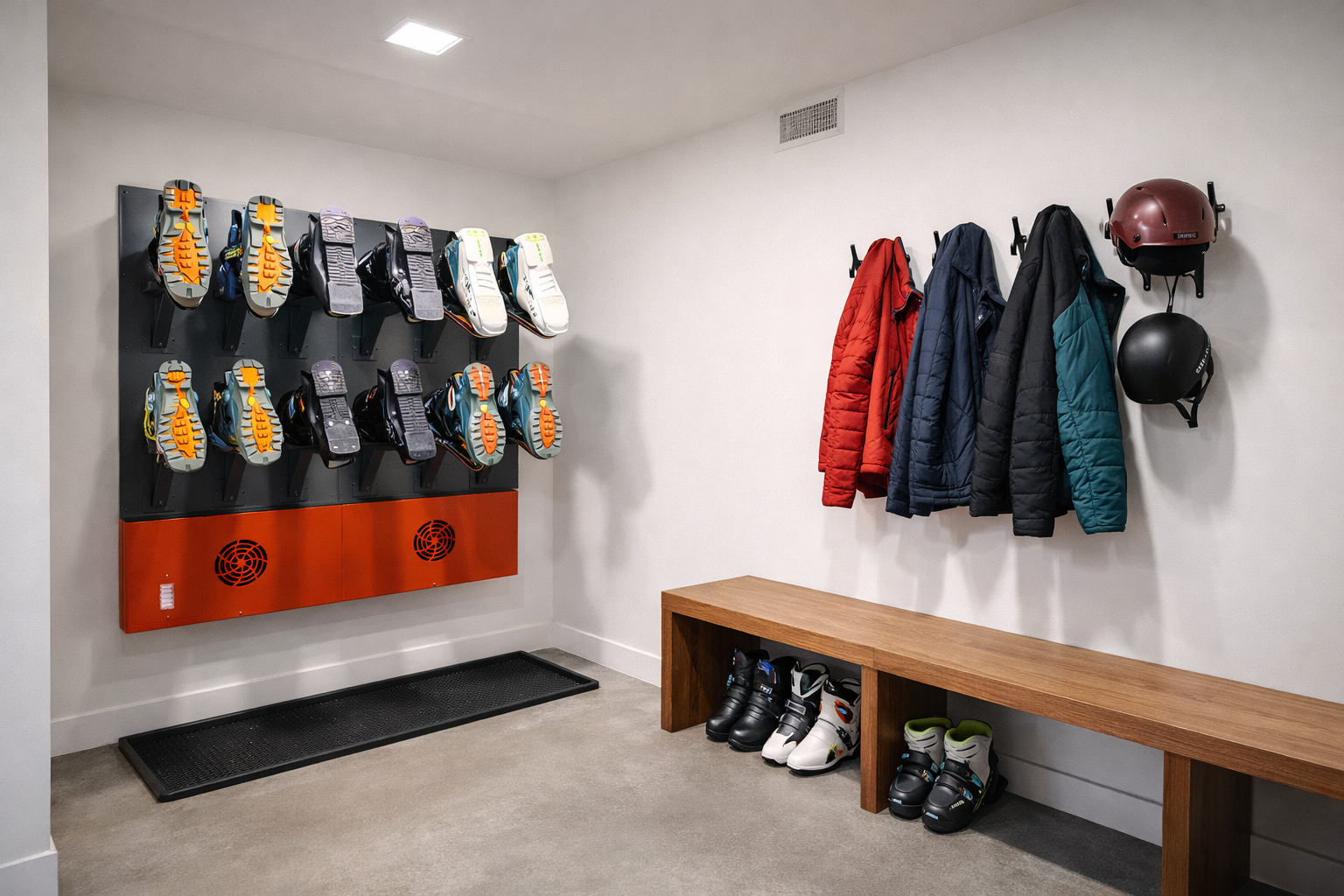
Drip Trays. Place a boot tray or drip pan directly below the drying station. For wall-mounted systems like the ALPINE DRYERS PRO, a tray on the floor beneath the unit catches everything that runs down during the initial drip phase. Rubber-backed commercial entrance mats also work well for this purpose.
Floor Drains. If you're building or renovating a dedicated gear room, a floor drain is worth considering. Floor drains are common in well-designed commercial gear rooms and fire stations, though not universal. For residential applications, it's a luxury, but one you'll appreciate. A simple 2-inch drain in the center of the room eliminates the need to mop up after every session.
The Pre-Dry Station. This is a detail most people miss. Before gear goes on the dryer, it should have a place to sit and shed its initial load of water and debris. A slatted bench or boot rack over a drip tray gives gear 15-30 minutes to stop actively dripping before it goes on the drying system. This reduces the moisture load on both the dryer and the room, and it keeps mud and grit out of your drying system.
Mounting and Layout
Where and how you mount your drying system affects everything from airflow efficiency to how many people can access their gear without a traffic jam.
Wall Mounting vs. Freestanding
ALPINE DRYERS PRO can be wall mounted in four different orientations (vertical with blower on top or bottom, horizontal with blower on left or right) or set up freestanding with optional base feet. Your choice depends on the space.
Wall mounting is the best option for most installations because it keeps floor space open for drip trays, benches, and foot traffic. Mount the unit so the lowest drying port is high enough that boots can be easily placed and removed without stooping. For most adults, that means the bottom port sits at about 36-42 inches off the floor.
Freestanding makes sense when you can't drill into walls (rental properties, temporary setups) or when you want to position the dryer in the center of a room for access from multiple sides.
Room Layout by Use Case
Family Mudroom (4-6 people): Mount a 6-pair system on the wall nearest the entry point. Place a bench across from it for sitting while removing boots. Keep a boot tray under the dryer and a separate mat at the door for initial snow knockoff. Hooks or cubbies on adjacent walls handle jackets, helmets, and other gear. Keep the traffic flow linear: door > mat > bench > dryer > storage.
Ski House (8-12 people): A 12-pair system (or two 6-pair modules) mounted along the longest available wall gives everyone a dedicated set of ports. Label the ports or assign positions to avoid the "whose boots are these" problem. Add a drying rack nearby for gloves, hats, and neck gaiters that don't go on the boot dryer. A second bench or shelf at waist height gives people a staging area.
Rental Shop (50+ pairs/day): You need multiple modular units configured for your volume. The modular design lets you start with what you need and expand as demand grows. Layout should separate incoming wet gear from outgoing dry gear. Wet boots come in one side, get processed through the drying system, and exit the other side clean and ready to rent. This prevents cross-contamination between wet and dry inventory.
Fire Station: Turnout gear drying requires space for full sets (boots, pants, coats, gloves, helmets, hoods) with enough clearance that gear doesn't contact other gear during drying. NFPA-aligned care and maintenance practices call for gear to be cleaned and thoroughly dried after use, and departments typically design drying rooms and systems with that expectation in mind. The drying room should be adjacent to the apparatus bay for fast access, with individual positions assigned to each firefighter.
Electrical Planning
A single ALPINE DRYERS PRO 6-pair unit runs on a standard 120-volt household outlet. That keeps residential installation simple, no electrician required for a single unit.
But think ahead:
- If you're running multiple units, make sure they're on separate circuits. Two 6-pair units on the same 15-amp circuit may trip the breaker.
- Position outlets close to the mounting location so you don't have extension cords running across the floor of a wet room. Extension cords in wet environments are a safety hazard.
- For new construction or renovation, have the electrician install a dedicated 20-amp circuit for the drying system. This gives you headroom for expansion and eliminates any concerns about shared circuit loads with other equipment.
- GFCI (Ground Fault Circuit Interrupter) outlets are recommended for any room where water is present. Many building codes already require them in spaces like garages and basements.
Temperature Considerations
The room temperature matters more than people think.
Boot dryers work by moving warm air through gear to accelerate evaporation. If the room itself is very cold (an unheated garage in January, for example), the dryer has to work harder because cold air holds less moisture. Drying takes longer, and the system uses more energy.
You don't need to heat your gear room to living-room temperatures. But you'll notice better drying performance above about 50°F. An insulated garage with a small space heater on a thermostat can handle this without running up your energy bill.
On the flip side, gear rooms that get too warm create their own issues. Excessive heat can damage boot shells, melt adhesive compounds, and degrade foam liners. This is one reason why putting gear near a fireplace or radiator is a bad idea. A controlled drying system with self-regulating heat elements avoids this problem because it adjusts output based on conditions.
Organization Beyond the Dryer
The dryer handles boots and gloves. What about everything else?
A well-designed gear room accounts for the full kit:
Helmets and Goggles. A shelf or hook system above or beside the dryer gives helmets a place to air out. Goggles should hang separately (not inside helmets) to allow air circulation around the foam and anti-fog coating.
Base Layers and Socks. A small drying rack or retractable clothesline handles the stuff that's too small or delicate for the boot dryer. Hang wet socks and base layers where the exhaust air from the dryer can reach them, and they'll dry faster from the ambient warmth.
Jackets and Pants. Heavy-duty hooks or a short section of coat rack lets outer layers hang and drip-dry. Position these over the drip tray area, not over dry storage.
Gear Storage. Once equipment is dry, it needs a home. Cubbies, labeled bins, or dedicated shelving keep dry gear separated from incoming wet gear. This sounds obvious, but in practice, most gear rooms become a pile of everything mixed together. Designating "wet side" and "dry side" zones fixes this.
The Five-Minute Version
If you don't want to overthink this, here's the minimum viable gear room:
- Pick a room or section with hard flooring and some ventilation (a window counts in a pinch)
- Mount your ALPINE DRYERS system on the wall at a comfortable height
- Put a boot tray underneath it
- Add a bench or chair nearby for boot removal
- Run a bathroom exhaust fan on a timer or crack a window during drying cycles
- Plug into a GFCI outlet
That covers 90% of residential needs. Everything else in this guide is for people who want to do it right the first time or who are setting up a space that handles serious volume.
Build It Once, Use It for Decades
The nice thing about a properly designed gear room is that it doesn't wear out. The dryer itself is built from powder-coated aluminum that lasts for decades. The room infrastructure (ventilation, drainage, electrical, layout) is permanent once installed.
Do the planning work upfront, and you'll have a space that keeps every piece of gear dry, organized, and ready to perform for years. That means more time on the mountain, on the job, or on the trail, and less time dealing with wet, smelly, deteriorating equipment.
And honestly? Walking into a gear room where everything is dry and organized and ready to go? That's one of the better feelings in winter.
Related Posts and Information
overall rating:
my rating:
log in to rate